
About a year ago I wrote about finally getting bees after taking a beekeeping class back in 2019. At the time, I had just installed four packages from Stonewall Apiary and was hoping I might eventually get enough honey for a fall harvest. A year later, the apiary has grown a lot faster than expected, although not always in the ways I originally planned. After starting with 4 packages last year, the apiary currently has 9 colonies.
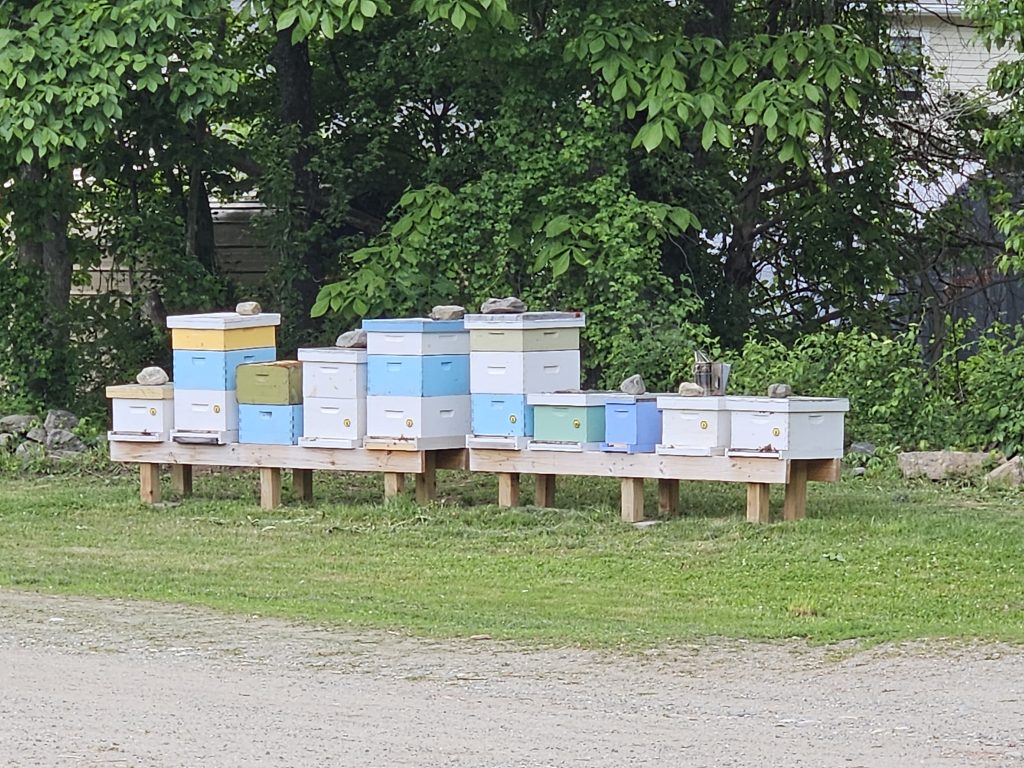
First, I did harvest honey in the fall of 2025. I bottled 43lbs of honey off only 2 hives. Over the course of the Summer of 2025, I split 1 hive into two, but both ended up queenless in the process. I was able to get both requeened and went into the winter with 5 colonies of bees; 3 very strong, 1 reasonably strong, and 1 week. I did add two nucs this spring that I ordered in the winter in case all the bees died.
One of the biggest things I’ve learned over the past year is that beekeeping seems to involve equal parts planning and reacting. Every time I thought I had the bees figured out, they came up with a new way to prove otherwise.
This spring started with 3 successfully overwintered colonies coming out strong. Hive 3 in particular turned into an absolute powerhouse and has consistently been the strongest brood producer in the yard. Hive 2 has also been incredibly productive and became the first hive to get a honey super this season. At one point I had enough strong colonies that I started making splits and trying to expand the apiary.
Some of those splits worked really well. Others… not so much.
I learned pretty quickly that introducing queens does not guarantee success. I had colonies reject queens, colonies that appeared queenless for weeks, colonies raising their own queens, and one hive that swarmed despite what I thought was plenty of room. One colony failed badly enough that I eventually stripped out the remaining resources and reused the equipment. Another hive swarmed into a nearby tree and I was able to capture the swarm and start a brand new hive from it. Somehow that “problem” ended up increasing the hive count again. Here is a video of me recovering a swarm.
At this point the apiary has grown from the original four package hives into a mix of production colonies, recovery colonies, nucs, and swarm captures. The current lineup includes several double deep production hives along with a number of smaller developing colonies. I’ve also ended up running a mix of Italian and Saskatraz queens from several different sources including Stonewall Apiary, Adam Fuller, and queens originating from my friend, Ian Dykens.
One thing that became obvious this season is how important queen quality is. Some queens build populations aggressively and keep beautiful brood patterns while others never really get traction. Watching colonies with different queens side-by-side has probably taught me more than anything else this year.
I also started keeping much more detailed records this season. Every inspection, mite wash, feeding, split, queen change, and swarm event has been logged. That turned out to be incredibly useful because after a few weeks all the hives start to blur together in your head. Looking back through the records made it much easier to spot trends and understand which colonies were improving and which ones were heading in the wrong direction. In 2025, I used a pre-made app on my phone, but found the data analytics to be lacking. I listen to the podcast “Beekeeping for Newbees” and had learned about using a wireless mic to record an audio record. I bought a $5 mic off Amazon that connects to my phone. Whenever I am getting ready to work in the hives, I start recording and just talk to myself while I work. When I’m done, the installed voice app will transcribe the recording which I upload into ChatGPT. I have a specific project there that I use to track my apiary activities and I transfer the data into a spreadsheet for record maintenance. The result is a much more complete record of what I do in my apiary.
The bees also taught me a few equipment lessons. The black plastic foundation frames have consistently produced terrible comb compared to wax-coated yellow foundation. Several hives drew out extremely uneven “wonky” comb on the black frames while building beautiful straight comb on the yellow ones. That experiment pretty much settled itself as I have been replacing all the black foundation frames.
Mite levels have stayed surprisingly low so far this year, with recent alcohol washes coming back at either zero or one mite per hundred bees. Hopefully that trend continues through the summer, although I know that can change quickly in New England.
At the moment the apiary is in a very different place than it was a year ago. Instead of simply hoping the packages survive, I’m now trying to balance honey production, swarm prevention, queen management, and expansion all at the same time. It has been a steep learning curve, but also one of the more interesting projects on the farm.